
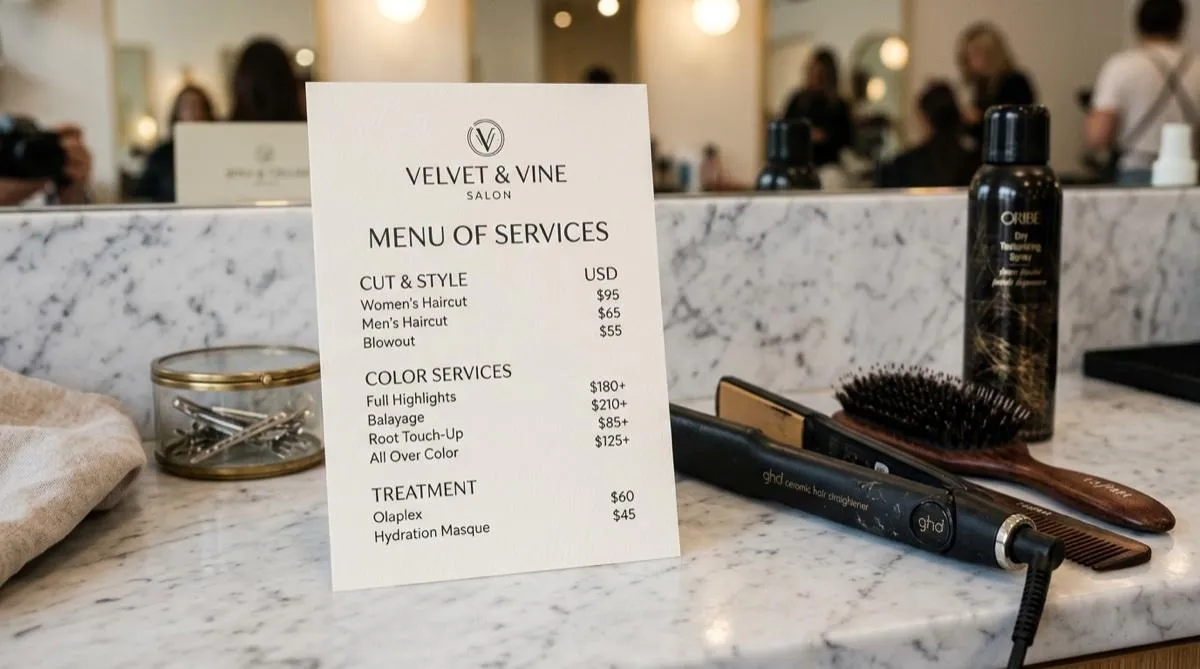
The average salon profit margin is 8%. That means on every $100 of revenue, $92 goes to product, rent, labor, and overhead. Eight dollars stays. Most salon owners do not know their margin. They set prices by Googling what other salons in the area charge, matching those numbers, and hoping it works out. It usually does not.
Why Copying Competitors Fails
The salon down the street charging $65 for a cut might be paying $800 a month in rent. You might be paying $2,200. Their product cost per service might be $4. Yours might be $9 because you use a better color line. Their prices are built on their costs, not yours. Matching them means you are subsidizing the difference out of your own pocket.
Pricing needs to start with your numbers, not someone else’s.
The Three Numbers That Set Your Price
Every service price should cover three things: what it costs you in product, what your time is worth, and your share of overhead.
Product cost is the easiest to calculate. Measure how much color, developer, toner, or treatment you use per service. A single-process color might use $12 in product. A balayage might use $22. Track it for a week and you will have accurate numbers.
Time value is where most stylists sell themselves short. If you want to earn $75,000 a year and you work 48 weeks at 35 billable hours per week, your time is worth $44.64 per hour. A cut that takes 45 minutes costs you $33.48 in time. A balayage that takes 2.5 hours costs you $111.60.
Overhead share divides your fixed costs (rent, utilities, insurance, software) across your working hours. If your monthly fixed costs are $4,500 and you work 140 hours a month, your overhead rate is $32.14 per hour.
Putting It Together
A 45-minute women’s cut: $7 product + $33.48 time + $24.10 overhead = $64.58 in costs. Add a 30% profit margin and you land at $83.95. Round to $85. That price is not pulled from thin air. It is built on your actual numbers. The Lutily service pricing calculator automates this math. Plug in your costs, time per service, and income goal, and it returns a price that keeps you profitable.
Balayage and High-Value Services
Balayage pricing in the US ranges from $150 to $450, according to 2026 pricing surveys. That is a wide range because the service varies wildly in time, skill, and product usage. A partial balayage on short hair might take 90 minutes and use $15 in product. A full balayage with a toner and gloss on long, thick hair could take 3.5 hours and burn through $35 in product.
Price the service you are actually performing, not a generic “balayage” line item. Some salons split their menu into tiers based on length, density, or complexity. For more on structuring your menu, see this breakdown of which services actually make you money.
When to Raise Prices
If you are booked out more than two weeks in advance, your prices are too low. If your product costs went up 10% last year and your prices stayed the same, your margin shrank. If you took a $2,000 advanced color class and your pricing does not reflect the new skill, you paid for education you are giving away for free.
Raise prices once a year at minimum. Communicate it simply: “Effective [date], my service prices will be updated to reflect current costs and continued education.” Clients who value your work will stay. The ones who leave over a $10 increase were never your long-term clients.
Stop Undercharging
The most expensive mistake in the salon industry is not a bad product order or a slow week. It is charging $60 for a service that costs you $58 to deliver. Two dollars of profit per service is not a business. It is a hobby with overhead. Know your costs. Price accordingly. Your skills are worth what you charge for them, but only if you actually charge enough.