
Building a SaaS product has never been easier. With modern development platforms, AI-assisted coding tools, analytics systems, and cloud infrastructure, founders can launch features, test ideas, and ship products faster than ever.
Marketing is a different story.
Many SaaS founders know they should be publishing content, sharing product updates, engaging with their audience, collecting customer feedback, and turning business milestones into marketing opportunities. The problem is that marketing can quickly become another job on an already crowded to-do list.
This is why a marketing system can be more valuable than simply adding another content creation tool to the stack.
Marketing Starts With the Business
A strong marketing process does not always require starting from a blank page. SaaS companies are already producing information that can become useful marketing content.
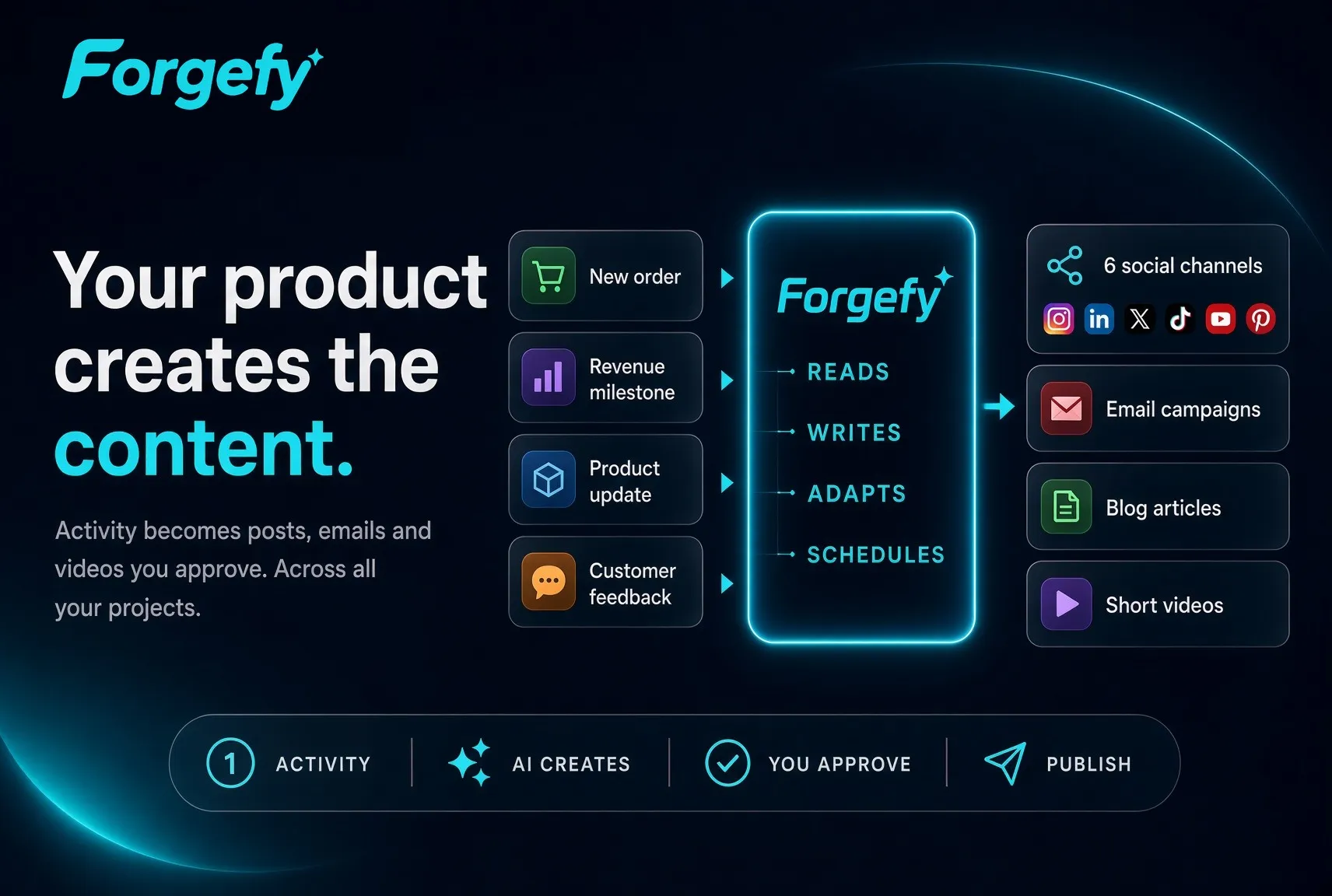
A new feature can become a product announcement. A customer question can become an educational post. A positive review can become social proof. A product milestone can become a social media update. A useful insight from a customer conversation can become an article or newsletter topic.
The challenge is creating a repeatable process that captures these moments and turns them into content.
Instead of asking, “What should I post today?” Founders can build a system around what is already happening inside the company.
This is one reason marketing automation for SaaS founders can be useful. Rather than treating content creation and distribution as completely separate activities, founders can create workflows that help move ideas from the business into their marketing channels.
The Problem With More Tools
SaaS founders often use several different platforms to manage marketing. One tool may be used for writing, another for scheduling, another for social media management, and another for tracking performance.
Each tool may solve an individual problem, but adding more software does not necessarily create a better marketing process.
In some cases, it creates more work.
Founders may have to copy content from one platform to another, rewrite the same idea for different channels, schedule posts manually, track which content has already been published, and remember when important business events should be turned into marketing opportunities.
The result can be a complicated workflow that requires constant attention.
A marketing system should reduce this friction rather than add another layer of complexity.
Build a Repeatable Workflow
The most useful marketing systems are built around repeatable processes.
For example, a SaaS founder could create a workflow where a product update is first reviewed, transformed into a short announcement, adapted for social media, and then added to a content calendar.
The founder still decides what should be published and approves the final messaging. The system simply handles repetitive steps around that decision.
This is where Forgefy can fit into a broader SaaS marketing workflow. Rather than relying on disconnected tools for every stage, founders can explore Forgefy as a way to approach Forgefy marketing automation around their existing business activity.
The important distinction is that automation does not have to mean removing humans from marketing. Instead, it can help founders spend less time performing repetitive tasks.
Content Marketing Automation
Content marketing becomes more manageable when businesses stop treating every piece of content as an isolated project.
A single business event can generate several useful content opportunities.
Suppose a SaaS company launches a major feature. The announcement might become a blog post, a short social media update, an email to existing customers, a product education post, and a discussion topic for the company’s community.
The core information remains the same, but the format and context change depending on the channel.
With content marketing automation, founders can create processes that help organize these transformations. This can make it easier to maintain a consistent publishing rhythm without requiring the founder to manually rebuild every piece of content from scratch.
Automation can also help with organization. Content ideas can be captured, reviewed, scheduled, and distributed through a defined workflow rather than being scattered across notes, spreadsheets, and different applications.
Marketing Automation for Founders
Founders have a unique challenge because they often remain involved in almost every part of the company.
Product development, customer support, sales, hiring, partnerships, fundraising, and marketing can all compete for the same limited amount of time.
That makes efficiency especially important.
Marketing automation for founders should therefore focus on removing repetitive marketing work while keeping important decisions under human control.
A founder may want to personally approve an important product announcement or customer story. But they may not need to manually format that announcement for every platform, move it between systems, or schedule every individual post.
Separating strategic decisions from repetitive execution can make a marketing process much easier to manage.
SaaS Marketing Automation
For growing SaaS companies, consistency can matter as much as volume.
Publishing ten pieces of content one week and nothing for the next month makes it difficult to build a predictable marketing process. A system can help founders maintain momentum by turning marketing activities into recurring workflows.
SaaS marketing automation can cover different parts of the process, including content planning, repurposing, scheduling, distribution, and workflow management.
However, automation should have clear boundaries. Not every customer interaction should become an automated post, and not every business event needs to be promoted publicly.
Human judgment remains important for deciding what is relevant, useful, timely, and appropriate for the audience.
Automated Marketing for SaaS
The goal of automated marketing for SaaS is not simply to publish more content.
The bigger opportunity is to make better use of the information a company is already generating.
Customer feedback, product releases, feature improvements, industry observations, case studies, and business milestones can all become potential marketing inputs.
A structured system can help capture these inputs and move them through the appropriate workflow.
For example, a customer repeatedly asking the same question could indicate an opportunity for educational content. A frequently requested feature could become a product-development story. A successful integration could become a tutorial or announcement.
The automation handles the process, while the founder or marketing team decides whether the underlying idea deserves attention.
One System Across Multiple Products
This approach becomes even more useful for founders managing multiple SaaS products.
Each product may have its own audience, positioning, voice, and content strategy. Managing them separately can create significant administrative work.
A centralized marketing process can provide a common operational structure while allowing each product to maintain its own identity.
Founders can define different workflows for different products, audiences, or channels without having to reinvent the entire marketing process each time.
This creates an important distinction between a marketing system and a simple content tool. A content tool primarily helps create content. A marketing system can help organize what happens before, during, and after content creation.
Keep Humans in the Loop
Automation works best when it supports human decision-making rather than attempting to replace it completely.
A useful workflow might automatically identify potential content opportunities, prepare drafts, organize assets, or suggest distribution steps. A founder can then review the material and decide whether it represents the company accurately.
This human-in-the-loop approach can be particularly important for SaaS businesses because product messaging often involves technical details, customer promises, pricing information, and positioning decisions.
Automation can accelerate execution, but founders still need control over the message.
Turn Business Activity Into Marketing
One of the biggest advantages of a marketing system is that it changes how founders think about content.
Instead of treating marketing as a separate activity that must constantly be created from nothing, founders can connect marketing to the normal operation of the business.
A product update does not have to disappear after the feature is shipped. A useful customer question does not have to remain buried in an inbox. A strong customer comment does not have to be forgotten. A revenue or product milestone can become part of an ongoing story.
When these moments are captured systematically, the business itself becomes a consistent source of marketing ideas.
Conclusion
SaaS founders do not necessarily need another tool that simply helps them create content. They need a practical process that connects the activity already happening inside their business with planning, creation, approval, and distribution.
Forgefy marketing automation can be considered within this broader approach, particularly for founders looking to organize repetitive marketing workflows while retaining control over important decisions.
The objective is not to automate every part of marketing. It is to reduce repetitive work, maintain consistency, and make sure valuable business moments have an opportunity to become useful marketing content.
For founders, that can mean spending less time asking what to post next and more time building products, talking to customers, and growing the business.