
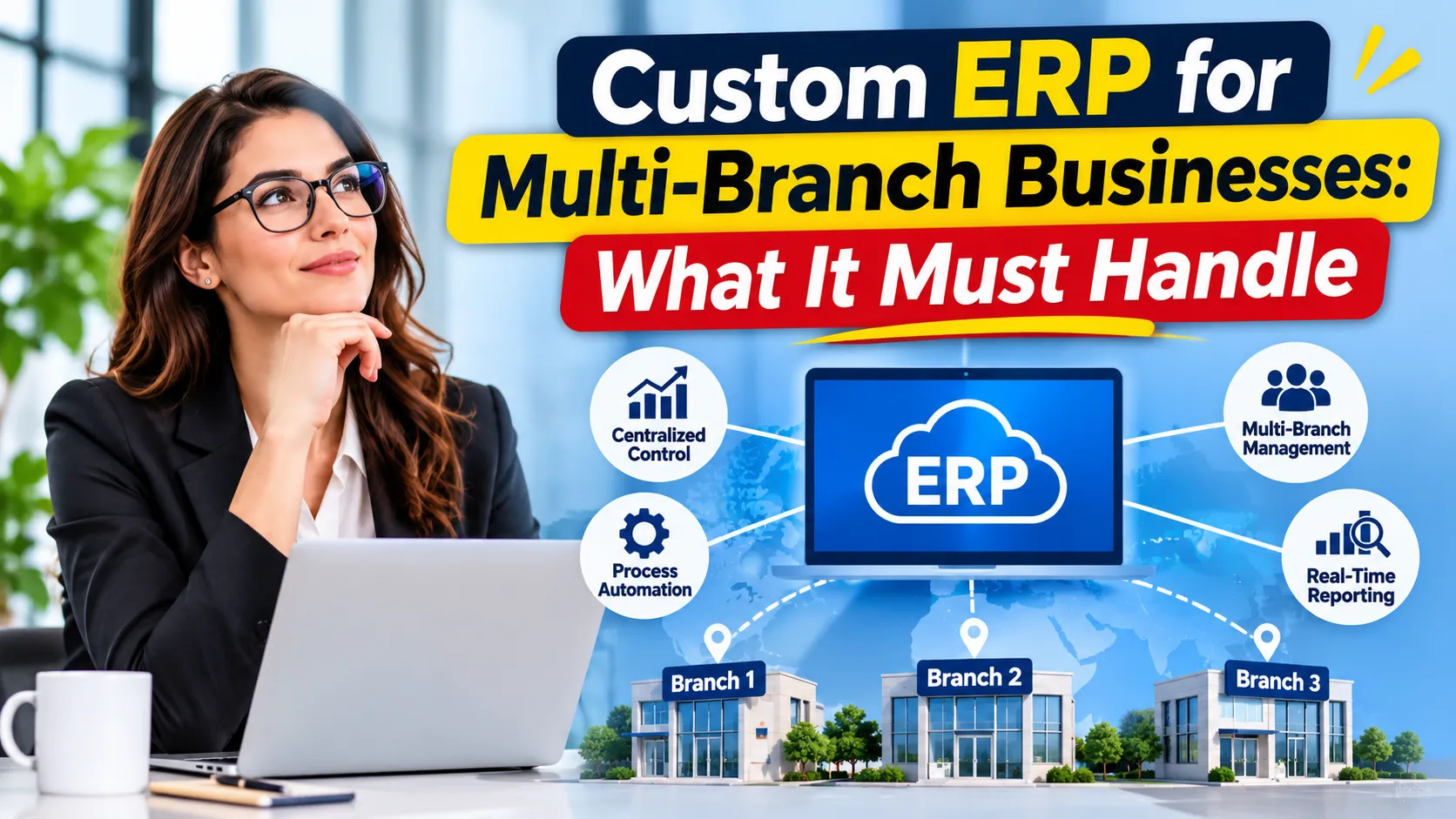
Two branches, you can run on spreadsheets and goodwill. Three, maybe four, still workable if someone’s obsessive about updating the shared sheet. Somewhere past that — branch five, six, seven — the cracks stop being occasional and start being structural. Stock counts drift. Month-end close takes forever. Nobody’s quite sure which branch manager can actually touch which numbers.
Generic ERP platforms were built for one location with several users, then stretched to cover multiple locations without rethinking the underlying assumptions. That’s the gap. And it’s why operators managing five-plus branches eventually stop trying to configure their way out of it and start talking to a custom erp software development company instead.
Four problem areas tend to surface first: inventory visibility, financial consolidation, access control, and tax compliance across jurisdictions. None of them look urgent at two branches. All of them become expensive at seven.
Inventory Visibility Across Disconnected Branches
Inventory failures in multi-branch operations rarely come from bad counting. They come from lag. A branch sells the last unit at 2:14 PM; the central system doesn’t register it until the overnight batch job runs, if the batch job runs at all that night. In that window, another branch promises the same unit to a different customer. Now someone’s on the phone apologizing instead of shipping.
A hardware distributor running six branches across two states hit this directly. Each location kept its own local database, with a shared spreadsheet bolted on for “central” visibility — updated by whoever remembered to do it that day. A regional manager planned a bulk transfer off numbers she thought were current. Three branches had already sold through the stock she was about to move. The transfer fell apart, and the customer waiting on that order went elsewhere.
What actually fixes this:
-
Real-time sync on every transaction, not a nightly batch — sales, returns, damage write-offs reflected within seconds, not hours.
-
Reorder thresholds set per branch based on real velocity, instead of one company-wide minimum that ignores regional demand swings.
-
Transfer logging that treats stock moving between branches as a recorded transaction rather than a phone call and a guess.
None of this is exotic. It’s just what an ERP looks like when it’s built around how stock actually moves across locations — which is the specific gap a custom erp software development company gets hired to close.
Financial Consolidation That Doesn’t Arrive Three Weeks Late
Branch-level books drift apart slowly, then all at once. One location files a utility bill under overhead; another files the identical expense under operations. Nobody notices until year-end reconciliation turns into something closer to forensic accounting. It’s not sloppiness, usually. It’s a chart of accounts that was never standardized across locations to begin with, so each branch quietly invents its own conventions over time.
An eight-store retail chain ran into this with its monthly close. In theory, books closed by the 5th. In practice, it took three to four weeks, because three of the stores were still running templates inherited from an old system migration that nobody had fully retired. By the time consolidated numbers reached the CFO, pricing decisions based on last month’s margins were already stale for this month’s costs.
The fix isn’t more spreadsheet discipline:
-
One enforced chart of accounts, group-wide — no branch-level customization outside pre-approved subcategories.
-
Daily automated consolidation instead of a manual export-and-merge ritual at month-end.
-
Automatic variance flags on any branch whose cost-to-revenue ratio drifts meaningfully from the group average, surfaced before the close, not after.
A three-week close isn’t really an accounting delay at that point. It’s a month of decisions made on numbers that were already out of date.
Role-Based Access That Actually Scales
Flat permission tiers — admin, manager, staff — hold up fine at two or three branches, where everyone basically knows everyone. At fourteen branch managers, some new hires, some covering for someone out on leave, that same flat structure starts handing out founder-level access to people who’ve been with the company six weeks.
At a regional auto parts chain, a branch manager filling in during a staffing gap adjusted a pricing field — meant to apply to her location only. The system had no location-scoped permissions, so the change propagated to the central price list. It undercut margins at four other branches for eleven days before anyone caught it. Nobody did anything wrong, technically. The system just never distinguished “manager of this branch” from “manager of everything.”
This is usually where a custom erp software development company earns its fee — not with generic role templates, but logic built around the actual org chart:
-
Permissions scoped to location, so a branch manager’s edit rights stop at that branch’s data, structurally, not by policy memo.
-
Audit trails on pricing, inventory, and financial changes, tagged to the user and branch where the change originated.
-
Approval workflows that kick in above a set dollar threshold, requiring sign-off before a change takes effect company-wide.
Access control isn’t a security footnote in a multi-branch setup. It’s what keeps one branch’s mistake from becoming everyone’s problem.
Jurisdiction-Specific Tax and Compliance Handling
Most generic ERPs assume one tax jurisdiction and one regulatory environment. That assumption holds until a business opens a second location somewhere with different tax slabs, different licensing rules, or different invoice formatting requirements — and then it doesn’t hold at all.
A pharmaceutical distributor expanded from one state into a neighboring one with a different tax structure and extra documentation requirements for controlled substances. Its existing system had zero concept of jurisdiction-aware tax logic. Staff ended up calculating the new state’s tax by hand on every invoice. Within the first quarter, a batch went out with the wrong rate applied, and that triggered a compliance review nobody wanted.
What this actually requires:
-
Tax logic tagged to jurisdiction, applying the right rate automatically based on branch or shipping destination — no manual override, no guesswork.
-
Invoice and documentation formats that adjust per region, since paperwork rules can differ even between neighboring states.
-
Compliance logs kept separately per jurisdiction, so a regulatory review at one branch doesn’t mean pulling records for the whole company.
Expanding into a state or region should be a growth milestone. Without jurisdiction- logic built in it turns into a compliance liability instead. Every new market brings its rules. Every new rule can create risk if not handled properly. That’s why having the systems, in place matters. It’s not about growing. It’s about growing.
Where This Shows Up in Practice: The Arobit Example
Arobit, an IT solutions provider working across ERP, CRM, and HRMS development, is one example of a company operating in this space — building systems meant to address exactly these branch-level coordination gaps rather than selling a single packaged product for every client. Its presence here reflects a wider pattern: multi-branch businesses are increasingly realizing that inventory sync, financial consolidation, access control, and tax compliance aren’t four separate problems. They’re symptoms of one architectural gap, and closing that gap is really the job of a custom erp software development company, not a generic software vendor.
Frequently Asked Questions
Q1: How is a custom ERP actually different from a heavily configured off-the-shelf system?
Configuration adjusts settings inside a fixed structure — it doesn’t touch the data model underneath. A custom build can restructure how branch-level data connects to central data in the first place, which configuration can’t replicate once complexity passes a certain point.
Q2: When does a multi-branch business actually need to make the jump to custom ERP?
There’s no clean branch-count trigger. The better signal is behavioral: once month-end close routinely runs past two weeks, or inventory mismatches between branches go from occasional to weekly, the current system has probably hit its ceiling.
Q3: Does more branches always mean more tax complexity?
Not automatically — only when branches cross jurisdictional lines. Two locations in the same city under the same tax authority carry a lot less complexity than two locations split across state or provincial boundaries.
Q4: Can role-based access be bolted on after the ERP’s already built?
Technically, yes. In practice, it’s a lot harder once teams have gotten used to flat permissions. Retrofitting location-scoped roles later usually means retraining staff and migrating audit history — slower and more expensive than building the permission structure correctly the first time.